








CHINESE NEW YEAR 2026 – 17th February 2026 – How we celebrate the year of the Yang Fire Horse Bing Wu
© Written by Jessica Hanna, 2025

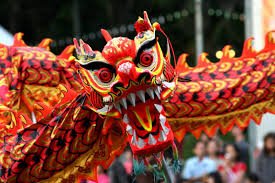
Chinese New Year will begin with the new moon, and is based on the Lunar calendar. In 2026 this falls on the 17th February. Lunar Chinese New Year is a day of celebration, a chance for family and friends to gather worldwide to welcome in the new year. Grand traditional celebrations often include delicious food and drinks, vibrant colours from flowers and other decorations, fireworks, elaborate dragon processions and the giving of those lucky red Ang Pow’s.
The Solar New Year differs from the Lunar and begins on the 4th February 2026. The difference between the two is that traditional celebrations are held on the Lunar New Year which is 17TH February 2026 and the placement of your annual cures and enhancers follows the Solar New Year which is 4th February 2026.
The Lunar New Year follows the Winter Solstice and is an occasion that marks new beginnings and fresh starts. An opportunity to reflect on the previous year, taking the positives into the new year and leaving the negative ones behind. The celebration represents gratitude and appreciation for the goodness in the world, honouring family and friend’s past and present.
Prior to Chinese New Year it is encouraged to spend some time preparing yourself and your home and work spaces. Visualise how you see yourself entering the New Year, practice gratitude, reflect on achievements, learn from mistakes and set future goals in all areas of your life. The space which you live and work should be clean, free from clutter allowing you to feel happier and motivated to achieve great things in the New Year and be the very best version of yourself.
There are several actions during the Chinese New Year that hold symbolic meanings. Sweeping the home signifies the removal of ill fortune and by deep cleaning, removing clutter, and organising the space removes stagnant chi and promotes the positive flow of fresh chi. Although I keep on top of clutter, cleaning and organising throughout the year we tend to spend the days leading up to the New Year being extra thorough, pulling out all the furniture and exploring those cupboards that are barely opened.
All your hard work will pay off just in time for the celebrations to truly begin.
It is quite common for the Lunar and Solar Chinese New Years to get mixed up with each other. These two dates have very different purposes.
Lunar Chinese New Year: the date that you celebrate – 17th of February 2026
Solar Chinese New Year: the date that you place your annual Cures and Enhancers – 4th February 2026.

For details on the day and time the Lunar and Solar Chinese New Year starts in your country, click here.
What happens during the Chinese New Year?
Celebrating Chinese New Year was never a thing in my family until I met Daniel. Now I celebrate every year, I have learnt what I have been missing. What more would I want than to spend the whole day with my nearest and dearest, eating copious amounts of food, full of smiles and laughter.
A day of reward, all the hard work of preparing yourself and your space can be celebrated. A day of being in the present moment, free from thoughts of past or future worries, and a chance to look forward to the exciting year ahead.
Last year, my little boy Lochie was old enough to enjoy the celebrations, receiving several Ang Pows and nourished by delicious food. The smile on his face was infectious. This year, with him being almost 3, he can look forward to not only celebrating it at home with us but also at his nursery. Each year, the nursery dedicates a whole week to the Chinese New Year, with all the children partaking in a number of activities which are not only fun but also offer plenty of learning opportunities. Last year, Lochie came home with a wooden snake he had crafted, dedicated to the snake year. I love to support the nursery with this special week, sending Lochie in with enough Ang Pows for everyone to take home and show their families. – new this year.
Chinese New Year celebrations tend to be at home, which I love as there is no better place to be surrounded by family and friends however I have been lucky enough in the past to attend the celebrations in London. What an atmosphere, the vibrant colours, the dragon parades and the pure excitement and joy on everyone’s face an unforgettable experience. Something I must do again in future years with Lochie, maybe even heading further afield. If your able to visit a place that celebrate big you won’t regret it! You will be flooded with happiness and joy, the ultimate energy boost.
Although the solar (Hsia) calendar commences the New Year at the beginning of Spring, which usually falls between the 3rd and 4th of February, the lunar (Yueh) calendar marks the New Year on the second new moon after the winter solstice. Celebrations and festivities for the Chinese New Year are held on this date. In 2026, the Lunar Chinese New Year, which also known as ‘Spring Festival,’ falls on the 17th of February 2026.
When is Chinese New Year 2026?
The Lunar Chinese New Year will fall on the 17th of February 2026 and this is the day to celebrate with family and loved ones. The Lunar year will end on the 6th February 2027.
The Lunar New Year is not to be confused with the Solar Chinese New Year which commences on 4th February 2025. This is the day you will place your annual Cures and Enhancers.
If purchasing any cues it is advised when you receive them to open the box and ensure all of the contents are present and there is no damage. This will give you enough time to repair/replace any damaged items. Once satisfied all of the cues and placements are good to go you can put them back in the box until the day of placement.
For details on the day and time, the Lunar and Solar Chinese New Year starts in your country, click here.
For information on the Lunar New Year and the 2026 Flying stars, you will find full details on THIS LINK.
Interesting Facts for Chinese New Year 2026
- The Chinese phrase for the Yang Fire Horse Bing Wu
- Horse Years: 2026, 2014, 2002, 1990, 1978, 1966, 1954, 1942, 1930
- Best careers for the Horse- Journalist, Politician, Leader, Engineer, Comedian
- The Horse personality: The Horse is very social, has a large network and loves to meet new people. They have good leadership qualities and are admired for their honest and to the point manor. With their persuasive manor they are good in debates but can at times suffer from a bad temper. The horse is determined to go far in life with their talents and likeable manor. The Horse likes to have a certain amount of freedom and independence in their life. They hate to be bound by the rules and regulations of society; they like to think that they should only have to answer to themselves. Despite this, they still like the support and encouragement of others.
- Famous Horses: Gordon Ramsey, Lou Reed, Harrison Ford, Sean Connery, Neil Armstrong
- Horse Protection Animal: Goat
- Horse conflict Animal: Rat, Ox, Snake
- Auspicious Flowers for the Horse: Iris, Jasmine, Calla Lily
- Auspicious Numbers for the Horse: 2, 7
- Inauspicious numbers for the Horse: 1, 6
- Auspicious colours for the Horse: Red, Pink, Purple
- Inauspicious colours for the Horse: Black, Blue
- Auspicious directions for the Horse: Southeast
- Inauspicious directions for the Horse: Northwest
- Chinese New Year is also known as the Spring Festival, and in China Chunjie (春节)
- It is the longest of the Chinese holidays
- No bathing, sweeping or throwing out rubbish allowed!
- You are expected to eat dumplings for every meal, every day
- Chinese New Year ends with the Lantern Festival
How do I prepare for Chinese New Year 2026?
The earlier the better! The list of to-dos prior to the new year commencing requires time. In the modern world there is always something to do or something that comes up at short notice. Our time is usually spent juggling all of the day-to-day tasks.
By being prepared and allocating plenty of time ahead of the Chinese New Year will enable you to remain calm and feel excited in the build-up to the celebrations. It will allow you to appreciate sitting down in a transformed space full of fresh energy to support and guide you into the New Year without rushing around trying to get things done last minute.
It is believed we start the New Year how we mean to go on so we want our energy to be bright, light and uplifted. Positively starting the New Year will benefit you in all areas of your life. If you don’t already, now is the perfect time to practice mindfulness and the skill of learning that every moment can be peaceful. This will benefit hugely when you’re in need of motivation and encouragement to get the list of jobs done before the Chinese New Year arrives.
Changing the way you approach chores will make them much easier to get done. I like to think of them as time for some much-needed headspace, easy tasks that don’t require much thought. With a good playlist on in the background, they even become fun, not to mention the movement is not only good for physical health, but the endorphins released after a few minutes will instantly put you in a feel-good mood.

The clutter that you have accumulated throughout the year should be thoroughly sorted. As William Morris would say “Have nothing in your house that you do not know to be useful, or believe to be beautiful”. This includes broken or damaged items throughout your home and workplace. If items have sentimental value, these can be held onto, but perhaps either have them fixed, given a new lease of life or find a safe place where they can be stored out of view.
We want to enter the year as we wish it to unfold, so it is essential that we pay particular attention to our finances, relationships, and health. Try to pay off any debts you owe, resolve any conflicts with loved ones and incorporate more fresh food and exercise into your daily life. All of these things will set you up for a happier, healthier version of yourself with a clear, positive attitude about what you wish to achieve in the New Year.
A summary of a few things to help you prepare for the New Year:
- Clear the clutter
- Remove all broken and damaged items
- Deep clean to include behind the furniture and dusting of the plants
- Clean windows and doors
- Avoid disputes, and try to make amends
- Reduce alcohol and caffeine intake
- Add more fresh fruit & veg into your diet
- Incorporate daily exercise- simply taking the stairs more
- Practice mindfulness
- Pay off debts, return and collect borrowed items
I’ve finished cleaning my home, now what?

Once everything has been cleaned, it is important to ensure the equipment themselves are clean and stored away. This includes the broom, dustpan, hoover, cloths and any other used items. A task that is often forgotten by many, including myself! However, ensuring all the equipment is clean and storing them out of sight will reduce the accumulation of negative Qi and they will be clean and ready to go for next time.
A critical part of Chinese New Year is the use of colours around the home and office and how they are displayed. The most common colour associated with Chinese New Year is the colour red, and you will usually see this used all around the home to promote luck, fame, and good fortune for the year ahead. Red is a fire colour and the most powerful of all the elements, it needs to be used correctly and when done so can provide you with so many benefits. It is advised that unless you are confident in the elements and their associated colours that you keep the spaces as natural as possible.
Protective talismans
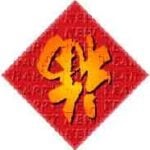
Protective talismans also play a critical role with Chinese New Year and are used to ward off evil forces and keep them away over the year and should be placed around your home, office or workplace throughout the year of the Horse. (click here to find out why you place these talisman charms and also to download a free printable copy). These auspicious and powerful protective talismans and couplets will be placed in buildings all around the world to bring good fortune and keep the occupants safe; the talismans will be printed on thick paper or card in red print or will have a red background as this colour is a life-giving colour in Chinese culture and is associated with summer, the south and the vermilion bird (similar to the phoenix) and also represents the fire element.
The use of Flowers and plants during Chinese New Year

Flowers and plants are another essential part in the preparation for Chinese New Year, and it is common to find bright, live, fresh and healthy blooming plants and flowers around the home or workplace during Chinese New Year as this is seen as a symbol of rebirth and new growth. The most commonly used plants will usually be bamboo, peonies, plum blossom and chrysanthemum, as they all symbolise wealth and high position in a person’s career.
It is believed that a lack of flowers in your home or business during the Chinese New Year will result in a lack of fruit during the year ahead, making this a critical item to have in your home during the Chinese New Year. Apparently, if you have a plant bloom inside your home or office on New Year’s Day, this will bring extremely powerful luck to the house and all of the occupants for the rest of the year. Pay particular attention to permanent plants in your living and work spaces, making sure they are given water regularly, and free from any dust.
The use of Fruit during Chinese New Year
Certain fruit is placed around the home during Chinese New Year and will typically be placed in the kitchen; place a bowl of fruit (oranges are great) in even numbers on your kitchen or dining table. When placing fruit in your home for Chinese New Year, you should place fruit in even numbers, and the best number of fruits you can place is eight, as this is an auspicious number in Feng Shui. The smell of fresh citrus fruit around the kitchen is very significant in our household as we associate this smell with the promise of a New Year ahead. The colour orange is associated with gold and is also a prominent colour during Chinese New Year, along with red decorations.
Kitchen God
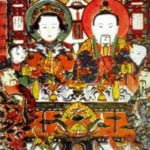
About a week before Lunar New Year, traditional families will be very busy preparing the religious ceremony, which is performed with tributes and offerings in honour of Heaven (Tien Shen) and Earth (Ti Tu), and of the various deities of the household together with family ancestors. One of the most well know deities associated with the Chinese New Year is the Kitchen God (also known as the stove god).
The Kitchen God watches over the stove, observing the household’s interactions. It’s believed that he compiles an annual report on the family’s activities throughout the year, presenting it to the Jade Emperor in Heaven approximately a week before Chinese New Year Day. On this day, rituals and offerings are dedicated to the Kitchen God, also known as Zhou Khun, in the hope that he will speak favourably of the family’s deeds.
The reunion dinner
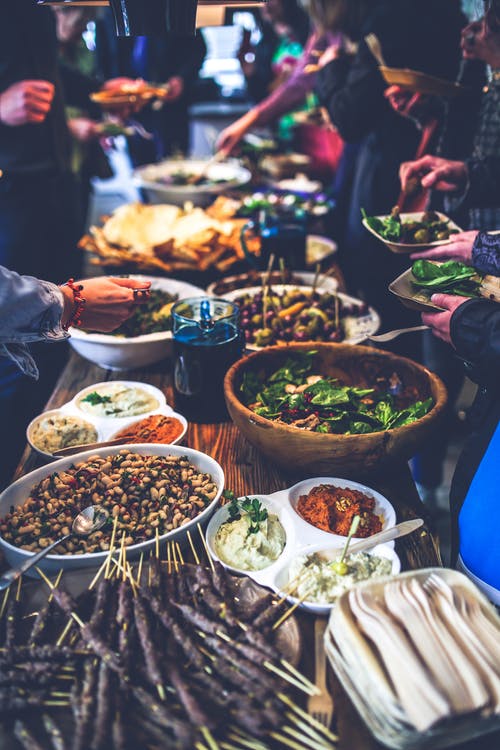
The highlight of Chinese New Year is the reunion dinner, a special occasion where all family members gather for a grand banquet in the family home to celebrate the approaching New Year. The younger generation typically travels back to their parents’ or grandparents’ house for this meal, symbolizing family unity. It’s a highly anticipated and exciting event for the entire family.
Families typically make the journey from their current homes to reunite with their loved ones for Chinese New Year. Similar to the holiday season in the West, flights in China tend to become more expensive during this festive period. The act of children returning to their family homes for Chinese New Year is regarded as a gesture of respect toward their elders, signifying the effort to be with family during this important time. Traditionally, for a married couple, it is expected for the wife to visit the husband’s family home. However, this practice is evolving, and it’s increasingly common for couples to visit both sets of parents or alternate between family homes, much like the arrangements for Christmas or Thanksgiving.
The reunion dinner table will be adorned with a variety of distinctive and visually appealing dishes, each carrying its own auspicious significance. To commence the reunion dinner, the family gathers at the family altar to express gratitude and pay homage by offering prayers to their ancestors and deities. They also present offerings to ensure a year filled with good fortune for everyone involved.
Most dishes served during the reunion dinner will have a meaning behind them, such as:
- Ginkgo nuts at the dinner table represent gold ingots and are said to bring luck with fertility.
- Black moss seaweed is a visually beautiful dish representing prosperity.
- A whole chicken at the dinner table is seen as a symbol of wealth.
- Dried bean curd is served at the banquet table to promote happiness and luck.
- Lotus seed is also said to increase fertility luck and signifies multiple offspring in the year ahead when eaten during the reunion dinner.
- Nian Gao is a traditional sweet, steamed glutinous rice pudding that is said to aid growth and abundance.
- Bamboo shoots will be placed as to when you translate into Chinese; the words sound similar to the Chinese for “Hoping that all turns out for the best”.
- A whole fish with the head and tail still intact will represent togetherness throughout the year.
Before the family gathers for the reunion dinner, it was traditionally the women’s role to come together in the kitchen, crafting the exquisite dishes. Meanwhile, the men would often convene to catch up or watch television, although nowadays, it’s more common to see both men and women sharing these responsibilities. A popular pre-dinner activity involves the family engaging in a game of Mahjong. This game involves building a wall of tiles and taking turns to create four suits and a pair. Mahjong is often associated with gambling, and significant amounts of money can change hands during play. Mastering Mahjong requires a sharp memory to keep track of laid-down tiles and those still in play.
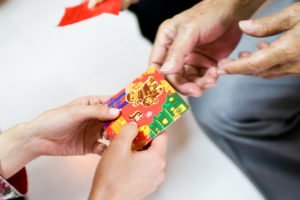
The younger kids will be bathed and dressed in fresh pyjamas, appearing neat and tidy. These pyjamas are typically replaced in the days leading up to Chinese New Year, symbolizing new starts and growth. As the children settle into bed, they are assured that ‘Tsai Shen Yeh,’ the god of wealth, will come while they sleep. The next morning, they’ll wake up to discover a red envelope, known as Ang Pow, under their pillow—a concept similar to the tooth fairy.
The children will also usually receive an Ang Pow red envelope from their grandparents and older family members on Chinese New Year. It’s also common for children to receive more money when they get older. Parents will gift more than an aunt or uncle. Someone who has a large family and who has taken a defeat on the mah-jong tables is in for trouble!
As the old year gives way to the new, the resounding bangs and bursts of fireworks echo through China and various parts of the world. These fireworks serve the dual purpose of dispelling malevolent spirits like the Nian monster and symbolizing the departure of old energy (Qi) while ushering in a fresh start. Unfortunately, in the UK, the use of fireworks during this period is restricted without special permission from the council, leading to a gradual fading of this tradition over the past 10-15 years. Nonetheless, there are plenty of other thrilling activities that unfold during this festive event.
Although fireworks have been banned in some countries, such as the UK, one tradition that is still going strong is the Dragon dance. At these ceremonies, you will find a group of performers from one to 10 people dressed as a giant dragon, dancing along to the rhythm of deafening music. The performers in the dragon costume will raise and lower a series of poles to make the dragon dance around, chasing the pearl of wisdom. The pearl will serve as a temptation for the dragon to search for wisdom and knowledge as he follows it to the sound of the thundering drums. The drums seem to help fill the void of the firecrackers, the energy is pumping, and everyone, old and young, are thrilled by the event.
The tradition of the Dragon Dance during Chinese New Year
The Dragon dance can be dated back to the Han Dynasty (202BC – 22AD) and was traditionally used as a ceremonial practice, offering respect and worship to ancestors and also to pray for rain during the year ahead, bringing fresh and bountiful crops for the village.
These days, the Dragon dance is more commonly known for entertainment rather than a dance of worship, and as of the Tang and Song dynasty, this was adopted as a crucial part of the celebrations over Chinese New Year.
The traditional storage location for the Dragon costume, when not in use, would have been in a Dragon king temple and would be collected from the temple on the day of the dance by members of the Dragon dancers. Being a dancer in the Dragon costume is a very skilled and tiring role, and they will usually practice the routine throughout the year as each turn and movement must be done to the beat of the drum.
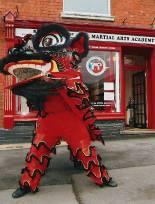
The Dragon dance comes with some interesting practices, and each has a different meaning.
- The body is attached to the head and is known as the ‘eye pointing’ ceremony
- There will be a performer walking in front of the dragon who is holding a long pole with a large ball at the end, signifying the pearl of wisdom, and the dragon will follow its every move, turning in carefully choreographed turns along the way
- When the dance is finished, the traditional practice is to burn the dragon’s head and tail and then return the dragon’s body to the dragon king’s temple. This is believed to return the dragon to ‘dragon heaven’ and bring good weather for crops in the year ahead. A new head and tail would be made at some point in the year, symbolising new beginnings
- Another common belief is that the burning dragon will repel bad luck and disasters for the year ahead.
What does the Lion dance have to do with Chinese New Year?
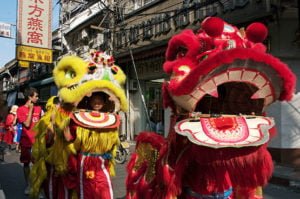
Yet another fascinating performance during Chinese New Year is the lion dance, also referred to as the lion lantern, akin to the Dragon dance but carrying distinct symbolism. The lion dance is typically executed on a smaller scale, with two men donning the lion costume, which features a mirror on top of the lion’s head to ward off evil spirits. With rhythmic drumbeats and the accompaniment of a gong, the lion dancers navigate the streets. Inside the costume, the performers mimic the movements of a real lion, executing precise and pre-planned choreography throughout the dance.
As the dancers inside the lion costume make their way along the street, they encounter another dancer dressed as a laughing Buddha. This Buddha figure dons a monk’s robe and a mask while holding a fan made of banana leaves. In the dance, the Buddha’s playful role involves teasing the lion by waving the fan in front of its face, guiding the lion along the street. For those who have witnessed a live lion dance, the memory often includes shredded lettuce scattered across the street. People hang lettuce, adorned with money, outside their homes and businesses as an offering to the dancers, symbolizing new beginnings in the upcoming year. When the lion reaches for the lettuce, it keeps the money and playfully shreds and spits out the lettuce along the street. It is considered highly auspicious if the lion takes your lettuce during this festive dance.
Common practices during day One of Chinese New Year
You’ve probably realised by now that nearly everything that takes place during Chinese New Year bears a special meaning behind it, and this also carries through to the first day of the New year.
The day’s celebrations will usually begin with good wishes to other friends and family for the year ahead, with everyone meeting up dressed in the new, smart clothes. Family members will then give out Ang Pow red envelopes to the younger generation with money inside to wish them a Happy New Year; unmarried adults will also get a red envelope from aunts, uncles, parents and grandparents on this day. The practice of giving out red envelopes is similar to toys and gifts being given out at Christmas. When giving an Ang Pow, it is considered lucky to give an even sum such as £8 or £20; the amount you give usually depends on the relationship with the recipient. For more information on red envelopes and their use in Chinese culture the link below details http://www.fengshuiweb.co.uk/advice/angpow.htm
Later in the day, the household will usually go out to visit aunts, uncles and other close family and friends. It is common practice to visit family members in order of age, so you would usually start by visiting Grandparents or great Grandparents if they are still alive and then Uncles, Aunts etc to wish them a promising year ahead. Visiting family members is an exciting time for children as they will usually receive an Ang Pow from each family member once they have greeted them with “Kung Xee Fa Chai” which translates to Congratulations, and may you be prosperous.
What happens on day Two of Chinese New Year?

The second day of the Chinese New Year is referred to as ‘Kai Nien’, which translates to ‘year beginning’, and you would traditionally begin Kai Nien with a very early breakfast with your family; the whole event of Chinese New Year is very much a family affair!
During the main meal of the day, you will usually eat a range of unique and beautiful dishes that will all have symbolic names and a special meaning behind each dish. The main focus of this meal will be based around the main dish, which will be a big bowl of long noodles, and you will throw them up into the air using your chopsticks to promote longevity in the year ahead. Anyone who is not able to join in with this activity will stay seated and watch the rest of the family stand up and raise their arms, launching the noodles into the air, which usually ends with noodles stuck on the ceiling!
Throughout Chinese New Year, people typically limit their alcohol intake, as it’s believed that excessive consumption may bring about problems in the coming year. The primary beverages during this festive period include substantial quantities of green tea and modest servings of Chinese wine. The second day of Chinese New Year is predominantly a family-oriented occasion, and it’s advisable to exercise moderation when it comes to alcohol consumption during this celebration.
The initial two days of Chinese New Year are filled with an abundance of food, fun, and games with family members, and it can be quite exhausting, given the Chinese inclination not to hold back during this festive season. The Chinese share a unique and significant connection with food throughout the year, but it is especially emphasized during the New Year celebrations. Many dishes served during Chinese New Year carry special meanings; even everyday fare like fish and turnips holds symbolic significance. Notably, dishes like fish balls and meatballs are particularly significant, symbolizing the theme of reunion.
What happens on day Three of the Chinese New Year?
After two full days of celebrations and eating, it Is not uncommon to need a rest, and this is where the third day of Chinese New Year will bring much-needed rest and relaxation to those celebrating. Day three of Chinese New Year is usually spent taking things easy, and the younger generation will usually go out to visit friends or just relax around the home. The tradition is that no offices or businesses will be open on the third day.
What happens on day Four of the Chinese New Year?
Normalcy begins to return on the fourth day of Chinese New Year, as numerous companies and shops resume their operations. Many businesses opt for an auspicious reopening date, consulting the Tong Shu Almanac to ensure a propitious start. A common practice is to organize a vibrant showcase featuring lion dances and firecrackers. This lively and thrilling event is not only enjoyed by employers and employees but also captivates passersby. The lion dance, performed on this occasion, is believed to usher in prosperity for the company.
Chinese New Year continued.
Celebrations will continue for another eleven days after Chinese New Year, right through to the full moon festival of the first lunar month when the ‘Spring lantern festival’ (Yuan Xiao Jie) will take place on the fifteenth day. The impressive ceremony will take place under a full moon.
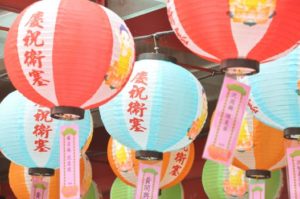
During the Spring lantern festival, every generation, no matter how old or young, will carry a beautiful, colourful lantern and will gather in a public area such as the town centre to admire and appreciate the first full moon of the year; this is similar to the Mid-Autumn festival. In China, there are still villages that hold large Tang Yuan (rice dumplings) cooking and eating sessions which I would love to attend one year, although Chinese New Year is an extremely busy time for us. The dumplings are round to symbolise family unity and togetherness. The mid-month spring lantern festival brings the seasonal passage of the New Year to an end.
What can I do before the New Year to achieve good luck?
- Make sure that your house, flat, workplace, shop or any other building is spotless from top to bottom, to encourage good luck in the coming year. On average, just before New Year, we take 2-3 days cleaning every single area of our home, which is quite a time-consuming activity but feels fabulous after.
- You should not wash or cut your hair on the first few days of the New Year; this is because “Hair” is a homophone for the word “fa” meaning “prosperity” in Chinese. Therefore “cut the hair” or “wash the hair” is perceived as “cut your prosperity” or “wash your prosperity away”.
- Ensure that you have all of your Cures and Enhancers cleansed and prepared for the 4th February, and be sure to check our world time converter to find out when to place your 2026 Feng Shui cures and enhancers
- Depending on weather conditions, it is very good to open all the windows and doors in every single part of the home as this is said to bring in clean, new good luck for the year.
- Avoid talking about death or anything negative on the first few days of the year. In modern days, horror films or any film with negative connotations would never be watched as this is said to bring negative thoughts in the year ahead.
- Do not purchase books in the first few days in the Chinese New Year. “Book” is a homophone for the word “Shu” meaning “loss” in Chinese.
- Do not cry on the first few days of the New Year or raise your voice to your children or any other member of your family. It is believed this will set the year ahead.
- Avoid arguing during Chinese New Year as it is said that this will lead to arguments for the rest of the year.
- You should switch on all of the lights in the home inside and out as this is said to attract good luck from outside, and if the windows and doors are wide open, it is easy for the luck to enter. The bright lights and open windows are also used to scare away evil spirits.
- Many people, especially Chinese, will buy a new pair of slippers at New Year’s. It is believed that this purchase will prevent people from gossiping about you. In China, face and reputation are very important.
- This is quite normal all around the earth, but one thing the Chinese spend a lot of time doing before New Year is bathing and they cover themselves with Pomelo leaves to enhance their health for the year ahead. Pomelo is the largest of citrus trees, and they grow as large as a bowling ball and are said to be very healthy to drink and eat.
- The Chinese believe that whatever happens to them on New Year’s Day sets how the year ahead will be for them; this is why they avoid arguments, avoid using knives or drive too far. They love to gamble on New Year’s Day as they hope to create good luck and wealth. You can read more on this below.
Rules and regulations the Chinese stick to on the Chinese New Year Day

- Everybody is in a celebratory mood over Chinese New Year’s, so people should not argue or disagree with each other.
- Parents should not punish or discipline their children. Otherwise, they will have more arguments during the New Year. It is common for naughty children to get a telling-off quite a few days later.
- Women should refrain from using a knife or scissors in the kitchen. The knife signifies anger and danger in the woman’s life, and the scissors predict the woman cutting people out of her life. Women do not prepare or cook meals on this day but eat leftovers and pre-prepared food from the day before instead.
- It is considered bad luck if you smash a plate, bowl, cup or any other similar kitchen crockery; this brings bad luck regarding finances throughout the year. All smashed and cracked crockery should be placed in a round container until the next rubbish collection day.
- If you were to sweep up rubbish or throw away rubbish on Chinese New Year’s Day, you would be sweeping or throwing away the wealth and luck that resides in your home so please don’t do any cleaning.
- Do not take a lunchtime nap on this day as this will encourage laziness throughout the whole year ahead.
- You should not wash on this day which means don’t take a bath, shower or wash your hair on Chinese New Year’s Day as this will wash away all good luck for you.
- Refrain from wearing black or white colours when visiting friends on this day, as these colours are associated with funerals and death. Great colours are orange or red.
- Do not eat rice or oat porridge for breakfast on this day as they are associated with the poor eating these meals in the past; this symbolises a loss of wealth. A good breakfast would be fruit.
- If somebody that you know or know of that has recently passed away, it is not advisable to visit a family member’s house that is connected to the recently deceased, as this could bring bad luck in 2026.
- Do not eat any meat during breakfast on this day. Many vegetarian Gods arrive at the Chinese New Year’s Day festival, and upsetting them could cause problems.
- When you wake somebody up on this morning, do not use their name as it is said that this person will be dependent on you all year long to motivate them.
- Refrain from taking medicine on this day (if possible) that is not essential for your health as this could symbolise weakness and could bring illness to you throughout some point of the year. Necessary medication must still be taken as usual, so please do not take any chances.
- Do not wash any clothes on this day, as Chinese New Year’s Day is the birthday of the god of Water.
- Do not collect any debts on this day, as you may find that you will be chasing money for the rest of the year of the Dragon.
- Do not let anybody take anything out of your pockets, purse, handbag or wallet as this symbolises money loss throughout the year, and please be careful when out as pick-pockets can also cause problems with this.
- Do not cut your hair or nails on this day, as it is believed that you will be bringing pain to your relations.
- Do not buy any shoes as it’s considered very unlucky; ‘shoe’ translated in Mandarin, means evil, and when translated in Cantonese, it means ‘rough’ although slippers are fine.
- Keep everything positive and do not talk about anything negative on this day as you will be setting an example for how the rest of your year is to be lived.
- When offering something, do not do so in fours; when ‘four’ is translated into Chinese, it sounds like death. An example would be not to place 4 or 24 – 34 04 worse still, 44 pounds/dollars in a red envelope
The understanding is that whatever you do on Chinese New Year, is what you will be doing for the rest of the year, so enjoy time with family and eat well.
I hope you have enjoyed reading this and we would like to wish you all a very happy, healthy, successful and New Year. We want to thank you for your continued support, please see below where you will find many more links on Chinese New Year and its traditions.

Visit the pages below for further details on the 2026 Chinese New Year.
Chinese New Year 2026 ** How to make your own Ang Pow ** Chinese Talismans for 2026 ** Chinese animal predictions for 2026 ** Flying star Xuan Kong 2026 ** Avoid the fury of the Grand Duke, three killings in 2026 ** Chinese New Year world time converter 2026 ** 2026 Cures and enhancers kits ** How to take a compass reading ** How to determine your facing direction ** Feng Shui software updated for period 9 ** Feng Shui resource ** Feng Shui Blog ** Chinese culture **






I appreciated y\this information very much. Wish I would have had it sooner… thank you